
Rainwater harvesting
systems, pumps and irrigation
Complete guide to understand the essentials: tank size, pump choice, connected automatic watering and smart gauge. Save up to 50% of drinking water.
overview Contents
water_drop Understanding a rainwater harvesting system
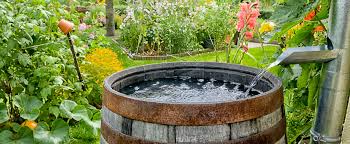
A rainwater harvesting system collects water from your roof, filters it and stores it in an above-ground or underground tank. This water can then supply your toilets, your washing machine, garden watering and outdoor cleaning.
In Belgium, where precipitation averages 800 to 1000 mm/year, such a system reduces mains water consumption by 40 to 50%.
How does it work?
- Roof collects rainwater
- The gutters direct it to a coarse debris filter
- A sieve filter removes leaves and fine particles
- The water reaches the tank via a submerged calming inlet
- A pump draws filtered water and distributes it into the household network
"A well-designed system can provide up to 100 litres per day per occupant, without any withdrawal from the drinking water system. "
science Sizing the tank
Sizing is the key step. Too small, your tank will often overflow; Too big, it will never fill completely.
The basic calculation
Annual recoverable volume = Roof area (m2) × Annual rainfall (m) × Loss coefficient (0.85)
Example for a roof 100 m2 in Belgium (rainfall 0.9 m/year):
100 × 0.9 × 0.85 = 76 500 litres/year
Recommended volume
| Use | Tank volume | Autonomy |
|---|---|---|
| Watering garden alone | 3 000 - 5,000 L | 4 - 6 weeks |
| Watering + WC | 5,000 - 7,500 L | 6 - 8 weeks |
| Full domestic use | 10 000 L | 8 - 12 weeks |
eco Tankio tip
Choose a 10,000 L tank if you want a maximum range. With a Tankio connected gauge, you will know exactly how much water is left before the next rain.
plumbing Choose your rainwater pump
The rainwater pump is the heart of the system. It must provide sufficient pressure (2.5 to 4 bar) and a flow rate adapted to your needs.
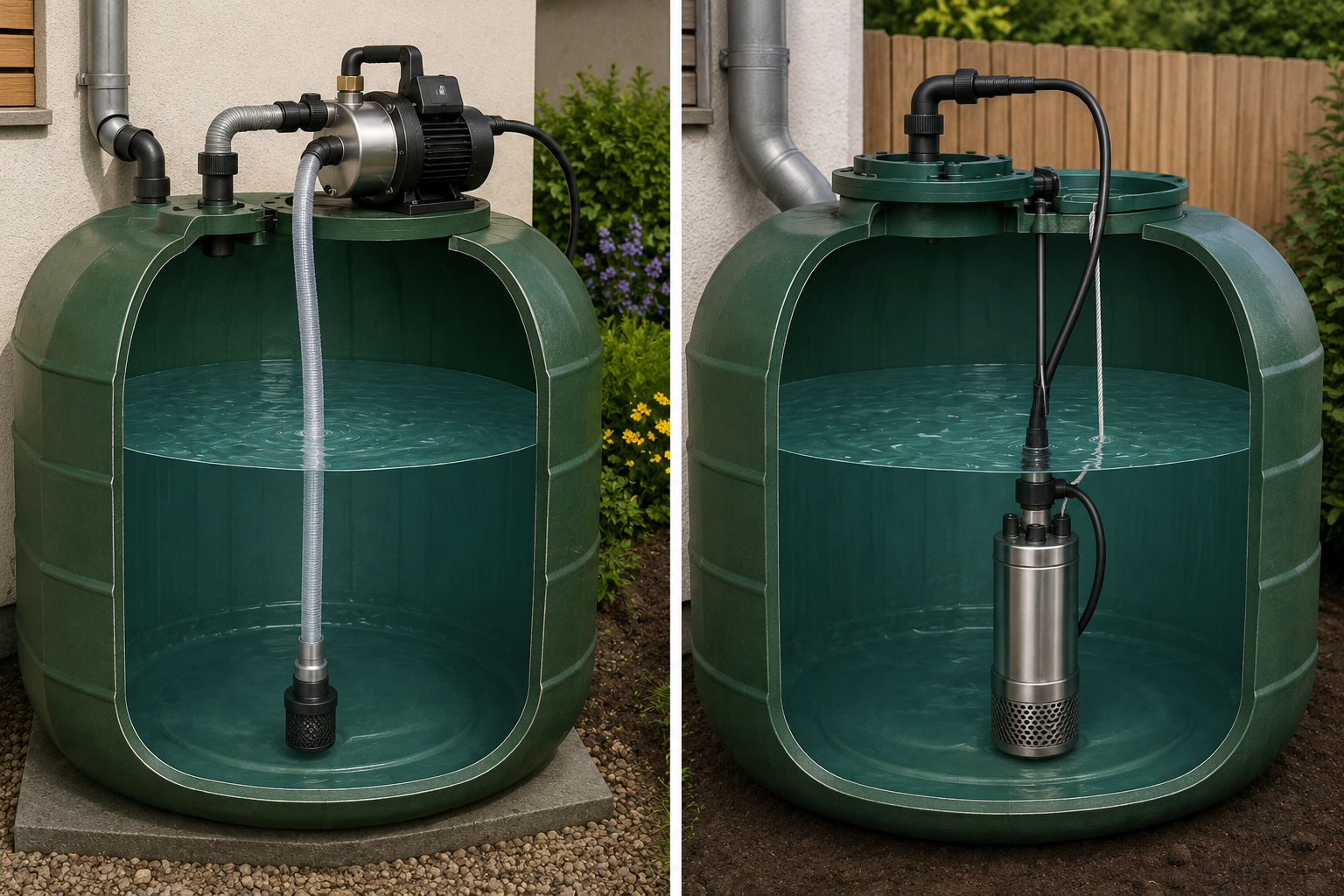
Surface pump vs submersible pump
| Criteria | Surface pump | Submersible pump |
|---|---|---|
| Location | Out of the tank (utility room) | Directly in the tank |
| Max depth | Up to 7-8 m | Up to 20 m+ |
| Noise | Moderate to high | Silent |
| Typical flow rate | 3 000 - 5,000 L/h | 4,000 - 6,000 L/h |
| Pressure | 2.5. - 3.5 bars | 3 - 4 bars |
| Maintenance | Easy (accessible) | Must be removed from the tank |
| Indicative price | 200 - 500 € | 400 - 1 000 € |
The pressure booster set
For optimal user comfort, combine your pump with a pressure booster set. This device maintains a constant pressure in the network and avoids unexpected pump on/off cycles.
Our recommendation
For domestic use (WC, washing machine + watering), choose a submersible pump with integrated pressure booster set: flow rate 4,500 L/h, pressure 3.5 bar, silent operation.
yard Connected automatic irrigation
Automatic watering is one of the main uses for rainwater. By connecting your tank to an irrigation system controlled by WiFi irrigation controller, you transform your garden into an independent ecosystem.
Benefits
savings Save up to 50%
Rainwater is free. By using it for your garden, you reduce your water bill by half.
rainy Intelligent watering
The connected rain sensor stops watering in case of precipitation. No more waste.
Installation steps
Install the pressure booster set after the tank outlet with a non-return valve.
Connect a WiFi irrigation controller to the main water outlet.
Deploy zoning valves to separate lawn, flower beds and the vegetable garden.
Install drip emitters or micro-sprinklers depending on the area.
Configure the watering schedules from your smartphone, with automatic activation depending on the weather.
"A well-adjusted automatic irrigation system uses 30 to 50% less water than manual watering."
settings Rainwater tank gauge
Knowing the exact level of your tank is essential to manage your rainwater stock. Without a reliable gauge, you may run out of water at the worst moment.
Types of gauges
| Type | Accuracy | Connected | Prices | Ideal for |
|---|---|---|---|---|
| Mechanical (float) | ± 5 cm | No | 20 - 50 € | Simple visual reading |
| Digital (ultrasonic) | ± 1 cm | Optional | 60 - 150 € | Local display |
| Connected (pressure) | ± 2 mm | Yes (WiFi) | €249 incl. VAT | Smartphone tracking + alerts |
Why Precision Matters
On a 10,000-litre tank, an error of a few centimetres can represent several hundred litres. The Tankio connected gauge uses a hydrostatic-pressure sensor with an accuracy of ±2 mm. You can view the remaining volume in real time and receive personalised alerts.
cycle Regulations and grants in Belgium
Rainwater harvesting is encouraged by the Belgian authorities, with varying regional requirements and attractive grants.
| Region | Obligation | Premium | Conditions |
|---|---|---|---|
| Flanders | Mandatory for new constructions | Up to 750 € (Mijn VerbouwPremie) | 5 000 L tank, WC connection |
| Brussels | Mandatory if roofing 100 m2 | Up to 1 000 € (WaterAct) | Degressive premium (50% first 5 m3) |
| Wallonia | Not mandatory (recommended) | Up to 850 € (UREBA + communal) | Resource ceiling, tank 3 000 L |
euro Reduced VAT rate
The installation of a rainwater harvesting system in a dwelling over 10 years of age benefits from the 6 % VAT rate instead of 21 %.
Before investing, check the premiums with your municipality: some offer additional aids for the installation of tanks and connected systems.
rainy System maintenance
Regular maintenance ensures the longevity of your facility and the quality of the water stored.
Gutters and roofing
Cleaning every 3 months (or after each fall) to avoid accumulation of leaves and debris.
Filter and debris screen
Inspect monthly and clean with a water jet. Replace the sieve every 2-3 years.
Pump and pressure booster set
Verification every 6 months : pressure, joints, suction strainer, pre-filter.
Tank and gauge
Emptying and cleaning every 5 years. Check your tankio gauge via the application to confirm the correct operation of the sensor.
"A well-maintained filter means a pump that lasts twice as long and better water quality."
search Frequently asked questions
Need help choosing your equipment?
See FAQ search