Tankio
Home Rainwater FAQs Blog Contact

IoT tank sensor:
everything you need to know before buying

LoRa or WiFi connectivity, battery life, accuracy, compatibility: complete guide to choosing the right IoT sensor for your rainwater tank in Belgium.

Are you looking to monitor your tank remotely but you don't know which sensor to choose? It's normal. Between the different technologies (LoRa, WiFi), measurement types (pressure, ultrasound), power sources and application functionalities, the market for IoT tank sensors may seem complex.

This buying guide gives you all the keys to making the right choice, adapted to your rainwater tank, your budget and your real needs. We have tested and compared the main solutions available in Belgium to offer you objective recommendations.

signal_cellular_alt 1. Types of connectivity: LoRa vs WiFi

The choice of connectivity is undoubtedly the most important decision because it determines the reliability, battery life and installation of the sensor.

LoRa (Long Range): the choice of reliability

The LoRa is a low-power radio technology specifically designed for IoT. Its advantages are decisive for tank monitoring:

  • Range up to 15 km in the open field, ideal for buried tanks or cellars.
  • More than 3 years of battery life thanks to a high-capacity battery and the LoRa link’s very low power consumption.
  • Generic public LoRaWAN services may be available in Belgium, but Tankio uses the included gateway and does not depend on a public LoRaWAN network.
  • tankio provides its own gateway included, without subscription.

WiFi: everyday simplicity

The Wi-Fi seduced by its simplicity of deployment: no subscription, no specific network. But be careful of the limits:

  • Range limited to 30-50 meters, does not penetrate concrete well.
  • Reduced battery life: batteries last 6 to 12 months.
  • Depends on the stability of your internet router.

For an outdoor cistern close to the house, WiFi may be sufficient. For an underground tank or deep cellar, LoRa is significantly more reliable. Discover our Tankio connected LoRa sensor designed for both uses.

sensors 2. Measuring technology: pressure vs ultrasound

The type of sensor determines the accuracy of the measurement. Two technologies dominate the market: pressure measurement and the ultrasonic measurement.

Ultrasonic sensor

The sensor emits an ultrasonic wave which is reflected on the surface of the liquid. The return time makes it possible to calculate the distance and therefore the level.

  • Advantages: without contact with liquid, easy to install, precise.
  • Disadvantages: does not work well with foam or thick vapors.
  • Ideal for: rainwater, clean tanks.

Pressure sensor (piezoresistive)

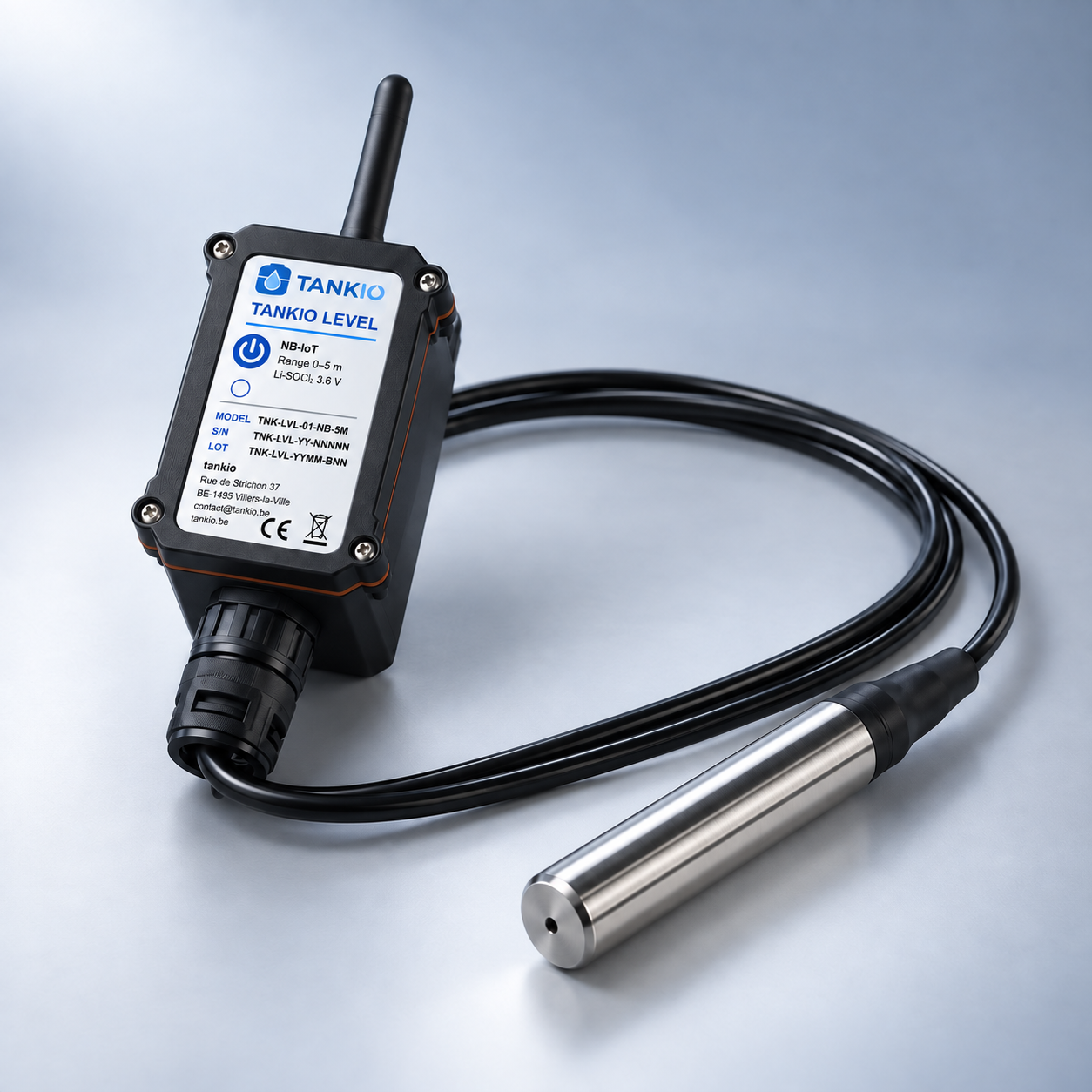
The sensor measures the hydrostatic pressure exerted by the column of liquid at the bottom of the tank. The pressure is directly proportional to the height of the liquid.

  • Advantages: very precise, insensitive to vapors, foam and turbulence.
  • Disadvantages: more complex installation, requires contact with the liquid.
  • Ideal for: all types of liquids, including those loaded with impurities.

Tankio recommendation

For a rainwater tank, the pressure sensor is more reliable in the long term because it is not disturbed by impurities or temperature variations.

battery_charging_full 3. Battery life and power supply

Battery life is a key criterion: a sensor that requires a battery change every month quickly becomes a constraint.

The different power sources

Type Battery life Maintenance Ideal for
High-capacity battery (LoRa) 3+ years None All types
Alkaline battery (WiFi) 6-12 months Annual change Easy access
Mains (220V) Unlimited None Tank near a mains outlet

The Tankio sensor’s high-capacity battery, combined with the LoRa link’s very low power consumption, provides more than 3 years of battery life without routine maintenance.

checklist 4. Compatibility with different types of tanks

Not all sensors are compatible with all tanks. Check these points before purchasing:

Tank type

  • Rainwater tank: Tankio uses hydrostatic pressure; ultrasound is discussed only as a generic market alternative.
  • Above-ground tank: all types are suitable, wide choice.
  • Buried tank: requires a sensor with LoRa communication (WiFi does not work).

Shape and dimensions

The tanks can be cylindrical, rectangular or irregularly shaped. Verify that the sensor and its app can convert measured height to actual volume taking into account the shape of your tank. tankio supports the most common shapes and allows manual calibration for atypical tanks.

Mounting hole

Most sensors mount to the tank port (gauge hole or fill hole). Measure the available diameter before purchasing. Standard diameters are 1 inch (25.4 mm) and 2 inches (50.8 mm).

phone_iphone 5. Mobile App Features

The sensor is important, but the mobile app is what you will use every day. Here are the essential features to check:

Essential Features

  • Real-time level display: in %, in liters and in height.
  • Consumption graphs: daily, weekly, monthly, yearly.
  • Customizable alerts: low thresholds, abnormal consumption, absence of data.
  • Estimated next filling date: based on your consumption rate.
  • Climate correction: comparison at equivalent outside temperature.
  • Multi-tanks: possibility of tracking several tanks on the same account.
  • Family sharing: provide access to several members of the household.

Advanced features (tankio)

  • Weather forecast: anticipation of needs for rainwater tanks.
  • Data export: for analysis in Excel or other tool.
  • Remote monitoring: track your level from anywhere.
  • Partner API: connection with your services.

euro 6. Price and budget: how much does it cost?

The price of an IoT sensor for a tank varies from €50 to €300 depending on the technology, features and brand. Here are the price ranges observed in Belgium.

Type Sensor price Subscription/year Cost over 5 years
Entry-level WiFi 50 - 80€ 0€ ~150€ (batteries)
Mid-range WiFi 80 - 150€ 0 - 20€ ~200€
Entry-level LoRa 100 - 150€ 3 - 10€ ~150€
tankio (LoRa) €249 incl. VAT 0€ ~€249 incl. VAT
GSM/4G 150 - 300€ 60 - 180€ ~600 - 1200€

Pay attention to the total cost: a cheap WiFi sensor can cost you more in batteries than a LoRa sensor that is a little more expensive to purchase but requires no maintenance for more than 3 years.

done_all 7. Checklist for choosing your IoT sensor

Before finalizing your purchase, review this checklist to make sure you haven't forgotten anything.

IoT tank sensor purchase checklist

  • Connectivity: LoRa recommended for an underground tank or cellar. WiFi possible if the tank is close to the router.
  • Type of measurement: Tankio uses hydrostatic pressure; ultrasound is not a Tankio product option.
  • Battery life: minimum 3 years, ideally more than 3 years for a LoRa sensor.
  • Tank compatibility: check the diameter of the orifice and the shape of the tank.
  • Mobile app: check features and user reviews.
  • Warranty: minimum 2 years, ideally 3 to 5 years.
  • Customer support: prefer a brand with support in French and based in Belgium.
  • Total cost: sensor + subscription + batteries over 5 years.
  • Made in Belgium: benefits for warranty support, availability and the local economy.